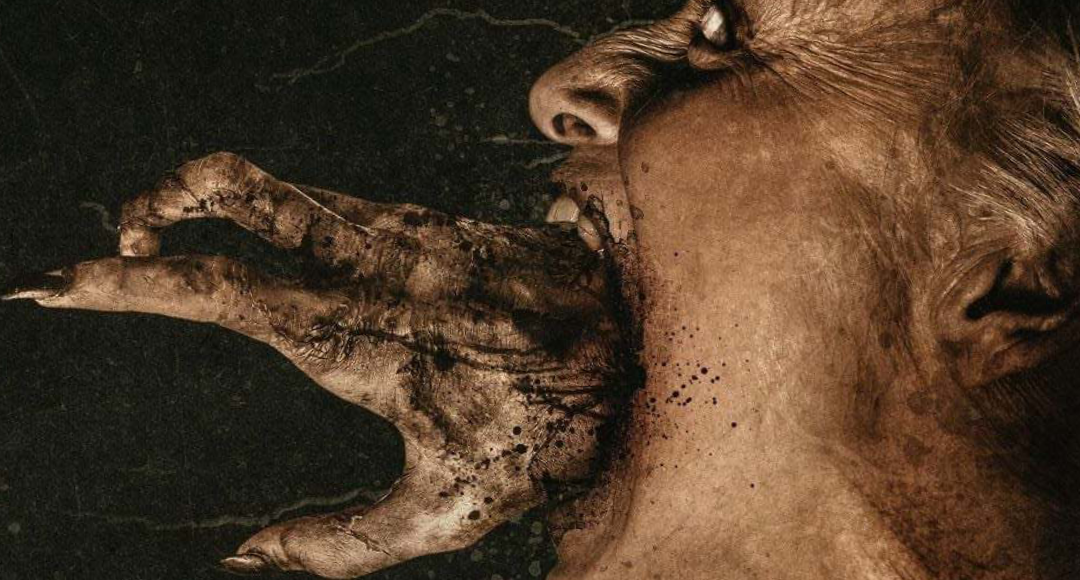
Bury the Devil is a brand-new Canadian horror tale from director Adam O’Brien, a filmmaker whose fingerprints are already all over the genre. O’Brien has produced an extensive catalogue of films and shorts, several of which he has directed himself. Aquaslash immediately comes to mind, particularly for one memorable sequence that became something of a calling card for the film.
O’Brien made his feature directorial debut in 2024 with Mom, starring two of Canada’s most recognizable talents: Schitt’s Creek’s Emily Hampshire and Heated Rivalry’s François Arnaud. That makes Bury the Devil feel like an important next step for O’Brien—a considerably more ambitious project that further establishes him as a distinctive voice within Canadian genre cinema.
The film’s most obvious hook, beyond its familiar battle between good and evil, is its presentation: Bury the Devil unfolds in a single continuous shot.
It’s a technique we’ve seen before, and one that can be particularly effective in horror. When executed well, the absence of traditional cuts forces the audience to remain trapped inside the same physical space as the characters. There is no escape, no reset, no opportunity to look away. But in an era dominated by hyper-edited content, three-second clips and an increasingly frantic visual language, committing to a single take feels less like a gimmick and more like a creative risk.
And, in this case, it largely pays off.
My first impression of Bury the Devil is that its greatest strength is its execution. O’Brien and his team function almost like an orchestra, with every department contributing to a carefully controlled, increasingly unsettling rhythm. The film doesn’t constantly scream for our attention. Instead, it patiently builds an eerie atmosphere and allows the darkness to gradually seep into the frame.
The story follows Julia, a hospice nurse played by Emmanuelle Lussier Martinez, during her first night caring for Evelyn, an elderly dementia patient portrayed by Dawn Ford. What initially appears to be an ordinary shift slowly begins to unravel as Julia realizes there is something profoundly wrong with the woman in her care—something that exists beyond sickness, memory loss or old age. Soon, surviving the night becomes the only priority.
The film is deliberately restrained: a single location, a small cast and a slow-burning narrative. But every passing minute brings us closer to whatever darkness is waiting around the corner. And I appreciate that.
There is something refreshing about watching a horror film actively resist the current obsession with speed. We live in a media landscape saturated with supercuts, short-form videos and visual stimulation designed to grab our attention within seconds. Everything has to be louder, faster and more colorful. Our attention is constantly being pulled in a dozen different directions.
Bury the Devil asks us to do the opposite.
It asks us to sit with the space.

The film takes its time establishing the geography of the house, allowing us to become familiar with its rooms, hallways and corners. But the house is more than a location. There is grief embedded in it. Memories linger on the walls. Objects suggest stories that existed long before Julia arrived. It feels like a house frozen in a very specific moment—a place that was once full of life.
As Evelyn’s dementia progresses, the house becomes a physical reminder of that past and of the person she is slowly losing.
Yes, the “creepy older woman” is one of horror’s oldest archetypes. Evelyn’s appearance initially seems to fit the template: long white hair, a nightgown and an unsettling presence. But O’Brien doesn’t immediately reduce her to a one-dimensional monster.
Instead, we are given fragments of her existence.
One of my favorite moments comes when Evelyn looks at herself in the mirror. It’s a surprisingly intimate scene involving someone who is slowly losing her connection to her own body and identity. Her behavior can shift from childlike to mature within seconds, creating an unsettling portrait of aging and cognitive decline.
As Evelyn prepares for bed, she begins to pray. At first, the scene feels familiar, almost comforting. But the words coming out of her mouth are not those of a traditional Christian prayer. Something else is hiding underneath the ritual.
This is where Bury the Devil begins to develop its mythology.
O’Brien, who also co-wrote the film, doesn’t necessarily give us every answer. Instead, he plants clues throughout the house: symbols, paintings and, most importantly, a small figure that Evelyn appears particularly protective of. These details gradually point toward a ritual gone wrong and suggest that something much darker has taken root inside the home.
The supernatural elements work because they are intertwined with something far more human: grief.
There is an interesting connection here to films such as Bring Her Back, where mourning becomes the emotional engine of the horror. How far would you go for another chance with the people you love? What would you sacrifice to reverse something that cannot be reversed?
Those questions run through the DNA of Bury the Devil. And they are embodied by our main characters.

While Evelyn is dealing with the deterioration of her own identity, Julia is carrying a different kind of burden. She is struggling with guilt surrounding her profession and with the emotional consequences of having avoided confronting her own mother’s decline. There is anger there, but also unresolved grief—feelings she has never really had the opportunity to process.
Julia is also new to the job, which makes her discovery of the house feel natural. Like us, she is learning the environment piece by piece.
A phone call with her father reveals another layer of her personal life: distance, resentment and unresolved friction. She has built a barrier between herself and her own family, perhaps because confronting those relationships would mean confronting everything she has been avoiding.
In that sense, Julia and Evelyn represent two extremes of the same emotional story.
One is a mother willing to cross the boundaries of nature itself to preserve her relationship with her daughter. The other is a daughter desperately trying to escape the responsibility and pain of watching someone she loves slowly lose their identity to illness and age.
Their stories are moving in opposite directions, but eventually, the supernatural brings them together.
As the night approaches its end, O’Brien’s direction begins to pull the threads together. Some of the questions raised throughout the film start finding their answers, while the action, horror and violence gradually escalate. There are certainly familiar genre tropes along the way, but Bury the Devil never seems particularly interested in reinventing the wheel. Instead, it focuses on how effectively it can use those familiar pieces within its own framework.
The camera becomes an important part of that escalation. The long, controlled movements that dominate the earlier sections gradually give way to more frantic, handheld camerawork. The shift keeps the film’s rhythm alive and, more importantly, makes the increasingly chaotic events feel physically immediate. The single-take concept begins to work more as a tool for tension.
The performances follow that same trajectory.

I particularly enjoyed the transformation Evelyn undergoes throughout the film. Dawn Ford fully commits to the character’s increasingly unhinged behavior, embracing both the physicality and the craziness of the material. There is something genuinely entertaining about watching her disappear further into the darkness.
Emmanuelle Lussier Martinez is equally effective as Julia. She gets several excellent WTF moments as the night spirals out of control, but what I particularly enjoyed was watching her survival instincts gradually kick in.
I won’t get into spoilers, but my favorite sequence is, in fact, the one featured prominently in the film’s posters. It’s the kind of scene that immediately communicates what the movie is willing to do once it finally lets loose.
And there’s that ending. I genuinely cheered.
It’s a jaw-dropping final stretch that brings the film’s various ideas together while making it clear that O’Brien was willing to swing big with Bury the Devil. Rather than simply following the path we expect from a supernatural horror story, the film plays with the assumptions and conventions that genre fans bring into the experience.
That willingness to challenge those expectations is ultimately what makes the film work for me.
Bury the Devil understands the value of taking familiar ingredients, putting them inside a very specific formal constraint, and then slowly turning up the pressure until everything breaks.
Leave a Reply