Three years ago, the horror landscape witnessed the birth of an unlikely cinematic phenomenon: the Twisted Childhood Universe. Its first entry, Winnie-the-Pooh: Blood and Honey, didn’t simply arrive—it crashed into the genre with the kind of audacious premise designed to provoke a reaction.
The idea was deceptively simple: take one of the most recognizable symbols of childhood innocence and nostalgia and drag him into the woods, strip away the sweetness, and turn him into a masked killer. The image of Winnie-the-Pooh as a slasher villain was enough to ignite conversations across the horror community long before audiences ever had a chance to see the film.
Controversy followed. Calls for boycotts circulated, debates over the exploitation of childhood nostalgia intensified, and the film became an internet talking point almost overnight. But controversy only fueled the machine. By the time Blood and Honey reached theaters, curiosity had already transformed into a full-blown stampede.
The film became one of the clearest examples in recent horror history of how viral marketing, online discourse, and word of mouth can elevate an obscure independent production into an international event. Whether audiences loved it, hated it, or simply couldn’t believe it existed, they were talking about it—and, more importantly, they were buying tickets.
Made for less than $50,000, Winnie-the-Pooh: Blood and Honey ultimately grossed approximately $7.7 million worldwide, turning its shoestring production into a remarkable box-office success and proving that, in the age of social media, a provocative horror concept can sometimes be more valuable than a Hollywood-sized budget.
Just one year later, the sequel arrived with considerably bigger ambitions. A larger budget, upgraded production values, expanded mythology, and higher stakes signaled that Blood and Honey was no longer simply a viral curiosity.
The experiment had become a franchise.
And now we arrive at the latest—and arguably most ambitious—chapter in the Twisted Childhood Universe: Pinocchio Unstrung, a full-blooded horror reimagining of Carlo Collodi’s 1883 novel The Adventures of Pinocchio.
The premise remains deceptively familiar. Our little wooden friend still dreams of becoming a real boy, but this time, that journey takes a considerably darker and bloodier path.
Pinocchio Unstrung represents the most ambitious production of Rhys Frake-Waterfield’s filmography to date. And the difference is immediately apparent. Compared with the marketing campaigns, first looks, and production values of the universe’s earlier installments, Unstrung feels less like an experiment built around a provocative concept and more like a fully realized horror feature.
The upgrade is substantial. The production feels bigger, more confident, and considerably more polished, suggesting that the talent and ambition behind this universe were always there—they simply needed room to evolve.
Perhaps that is the most interesting aspect of the Twisted Childhood Universe so far. The filmmakers finally have the resources, experience, and confidence to embrace it fully. For the fans who stuck around through the growing pains, Unstrung feels like a reward. And for the skeptics who dismissed the universe early on, perhaps it’s time to reconsider.
The film centers on James, played by Cameron Bell, a young boy growing up under the care of his grandfather Geppetto, portrayed by horror icon Richard Brake. James has already endured more loss than most children should ever have to face. He lost both of his parents in a tragic accident and, later, his best friend to cancer.

Desperate to give his grandson something to hold on to, Geppetto makes an extraordinary promise: he will build James a friend who will never leave him. That promise gives birth to Pinocchio.
At first, Geppetto’s latest creation seems to be everything James needs. A wooden companion with a mischievous personality and a familiar supernatural quirk—his nose grows whenever he lies—Pinocchio quickly becomes James’ closest friend. Away from the safety of home, however, James’ life is far less idyllic. He and his classmate Dudley, played by Jack Art Gray, are subjected to bullying and abuse from a group of older kids.
For James, Pinocchio becomes a refuge—a calming presence in an otherwise chaotic childhood. But as his protective nature grows stronger, Pinocchio begins to face his own dilemma: if becoming a real boy is what it takes to truly protect James, how far is he willing to go to make that dream a reality?
While James is away at school, Pinocchio begins exploring the house, eventually venturing into the basement. There, hidden in the darkness, he encounters a grotesquely disfigured wooden creature who reveals a horrifying truth: he is still nothing more than a puppet.
If he truly wants to become a real boy, he will need something his wooden body cannot provide on its own—human organs.
What follows is a bloody descent into violence as Pinocchio begins hunting for the pieces of humanity he believes will finally make him real.
In Pinocchio Unstrung, the dream of becoming a real boy remains intact. It’s the price of that dream that has changed.
One of the film’s greatest strengths is its willingness to fully embrace its camp and inherent silliness without ever allowing the horror to lose its teeth. Pinocchio Unstrung knows exactly how ridiculous its premise can be, but it never forgets that this is, at its core, a bloody slasher movie.
And before anything else, there is one element that deserves to be singled out: Pinocchio himself.

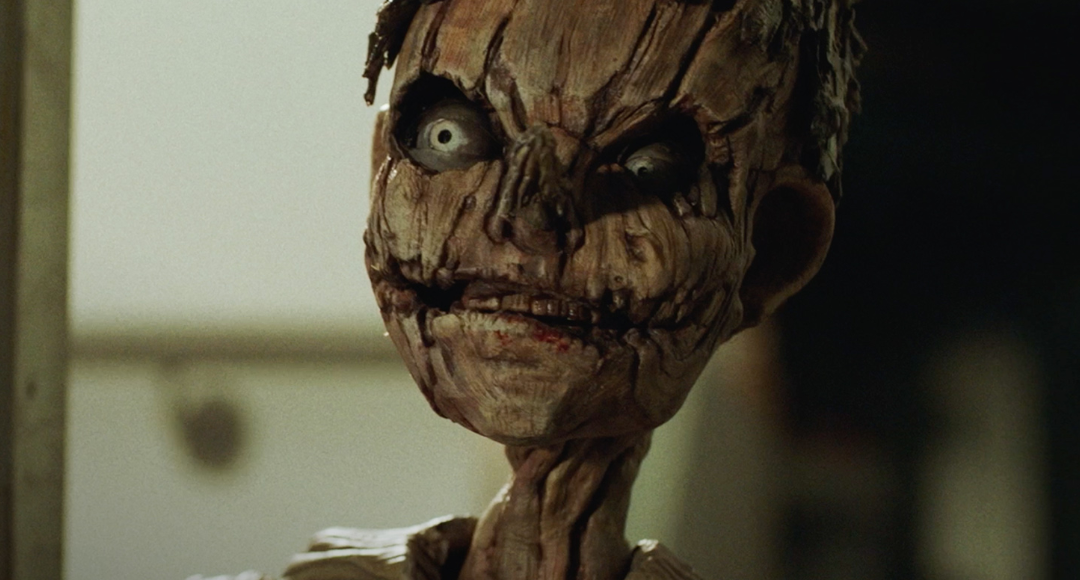
Behind the strings is makeup effects artist Todd Masters, one of the genre’s most accomplished craftsmen when it comes to creature design, practical effects, prosthetics, and monster-making. Through Masters FX, his team brings this twisted version of Pinocchio to life as a creature that feels instantly worthy of a place in any horror fan’s collection.
He is equal parts adorable and sinister. The carved wooden body, elongated limbs, imposing size, physical movement, and wonderfully tactile construction come together to create a character that feels like a genuine animatronic nightmare. It is a masterclass in practical creature effects—and thankfully, the film knows exactly where its greatest asset lies.
Pinocchio is everywhere.
The movie is fundamentally his story, and that commitment pays off. Pinocchio Unstrung puts him front and center, allowing the audience to appreciate the craftsmanship in almost every frame. The decision to rely on practical effects as much as possible gives the film a tactile, textured quality that makes Pinocchio feel tangible—and, at times, genuinely unsettling.
Adding another layer to the character is Jude-Evan Lloyd, who delivers excellent vocal work as the titular puppet. His performance gives Pinocchio a personality that goes beyond the physical design, balancing innocence, curiosity, and an increasingly disturbing sense of purpose.
The film also benefits from a noticeable upgrade in its casting, bringing bigger genre names into the Twisted Childhood Universe.
Richard Brake takes on a role we haven’t quite seen from him before: a loving grandfather willing to do almost anything to keep his grandson happy. For much of the first half, Brake plays Geppetto with a surprisingly sweet, gentle, and mysterious energy, giving the character considerably more emotional room than his horror persona might initially suggest.
But don’t worry—this is still Richard Brake we’re talking about. There is plenty of opportunity for the Brake we all know and love to emerge. Saying anything more, however, would venture dangerously close to spoiler territory.
And then there is Robert Englund. The horror legend lends his unmistakable voice to the infamous cricket, but this version of the character is far removed from the comforting conscience audiences might expect. Here, the cricket functions more as a corrupting influence than a moral guide, and Englund clearly has a great deal of fun with the material.
His dialogue provides some of the film’s most entertaining moments, packed with references and little nods to the legacy that made Englund an icon of the genre. It’s fan service, certainly—but the kind that feels earned, especially when delivered in that unmistakable voice.
Beyond the veteran genre names, the younger cast brings an adventurous energy to the film, along with some of its funniest dialogue. Cameron Bell is particularly compelling as James, making his bond with Pinocchio feel genuine enough that you actually become invested in their friendship—and in what happens when that friendship begins to take a darker turn.
But if anyone steals the show, it’s Jack Art Gray as Dudley. Serving as the film’s primary source of comic relief, Gray brings an infectious energy to the character, turning Dudley into one of the movie’s most entertaining surprises. Jessica Balmer and Toni Olabanji round out the young ensemble, bringing additional layers to James’ world as his love interest and primary rival, respectively.
Of course, what would a killer-doll movie be without the kills? And Pinocchio Unstrung certainly delivers.

The kills are impressively gory, practical, and—perhaps most importantly—given enough time to let the carnage breathe. Rhys Frake-Waterfield sends Pinocchio through a variety of inventive settings, including a gym, a dentist’s office, a swimming pool, and several other locations that become playgrounds for the puppet’s increasingly killing rampage.
It’s another area where the film demonstrates just how far this universe has come. The production quality has received a significant upgrade, but the filmmakers haven’t sacrificed the unapologetically nasty spirit that attracted horror fans in the first place.
The gore is plentiful, the practical effects are front and center, and the entire experience carries the chaotic energy of a bloody slasher designed to entertain. And honestly, it works.
Pinocchio Unstrung is bigger, bloodier, sillier, and considerably more polished—and that combination makes it one of the most fun entries in the Twisted Childhood Universe so far.
Leave a Reply